
At JBI Consulting, we know that a well-crafted go-to-market strategy is essential for business success.
In this post, we’ll show you how to build a go-to-market strategy that drives results. We’ll cover everything from understanding your target market to creating an effective marketing and sales plan.
Get ready to transform your approach and boost your market presence.
Who Is Your Target Market?
Conduct Thorough Market Research
Understanding your target market forms the foundation of any successful go-to-market strategy. Businesses that truly grasp their audience often outperform those that don’t. Start by collecting hard data about your potential customers. Use tools like Google Trends to identify emerging patterns in your industry. Forrester’s B2B marketing and sales predictions analyze the dynamics and emerging trends that B2B organizations need to look out for in the year ahead. This insight into buyer behavior should inform your approach to market research.
Don’t limit yourself to online tools. Conduct surveys, interviews, and focus groups with your existing customers and potential leads. Ask about their pain points, decision-making processes, and factors that influence their purchasing decisions. This qualitative data can provide invaluable insights that numbers alone can’t capture.
Define Your Ideal Customer Profile
After you collect data, create a detailed picture of your ideal customer. Go beyond basic demographics. Consider psychographics, behavior patterns, and motivations. For B2B companies, factors like company size, industry, and decision-making structure play a critical role.
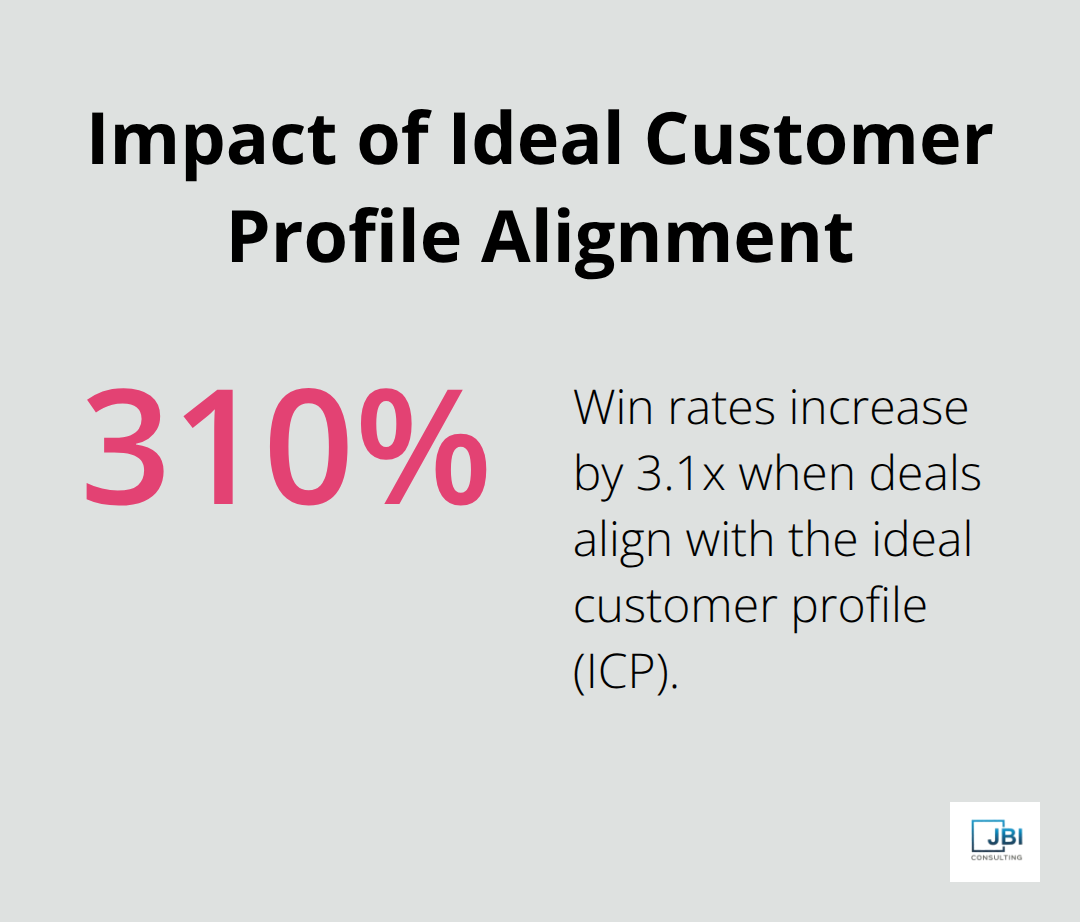
Win rates increase by 3.1x when deals align with the ideal customer profile (ICP). This statistic underscores the importance of getting your ICP right. Try to create a comprehensive profile that includes both quantitative and qualitative characteristics of your ideal customer.
Analyze Competitor Strategies and Positioning
Understanding your competitors is as important as understanding your customers. Conduct a thorough analysis of your top competitors’ strategies, strengths, and weaknesses. Tools like SEMrush or Ahrefs can provide insights into their online presence and marketing tactics (use these tools to gather data on keyword rankings, backlink profiles, and content strategies).
Pay attention to how competitors position themselves in the market. What unique selling propositions do they highlight? How do they communicate with their audience? This information can help you identify gaps in the market that your product or service can fill.
The goal isn’t to copy your competitors but to differentiate yourself effectively. As Michael Hinkle, our expert at JBI Consulting, often says, “Your unique approach to solving customer problems is what will set you apart in a crowded market.”
A comprehensive understanding of your target market, a detailed ideal customer profile, and a thorough analysis of your competition will guide every subsequent decision in your go-to-market strategy. This knowledge will shape your product development, inform your marketing messaging, and ultimately drive your success in the marketplace. Now, let’s explore how to develop a compelling value proposition that resonates with your newly defined target market.
What’s Your Unique Value Proposition?
Pinpoint Your Differentiators
A strong value proposition can significantly impact sales success. Start by identifying what sets you apart. This could be a unique feature, superior quality, exceptional customer service, or innovative technology. Salesforce dominates the CRM market not just because of its robust features, but also due to its cloud-based model and focus on customer success.
To uncover your differentiators, ask yourself:
- What problem do we solve better than anyone else?
- What unique expertise or resources do we bring to the table?
- How do our customers describe us compared to competitors?
Bridge the Gap Between Features and Benefits
Many companies focus solely on product features. However, customers care more about how these features benefit them. Transform your feature list into a benefit-driven narrative.
For instance, instead of saying “Our software has AI capabilities,” say “Our AI-powered software reduces data entry time by 50%, allowing your team to focus on high-value tasks.”
Craft a Compelling Message
Your value proposition should be clear, concise, and compelling. It should immediately resonate with your target audience and address their pain points.
Here’s a framework to craft your value proposition:
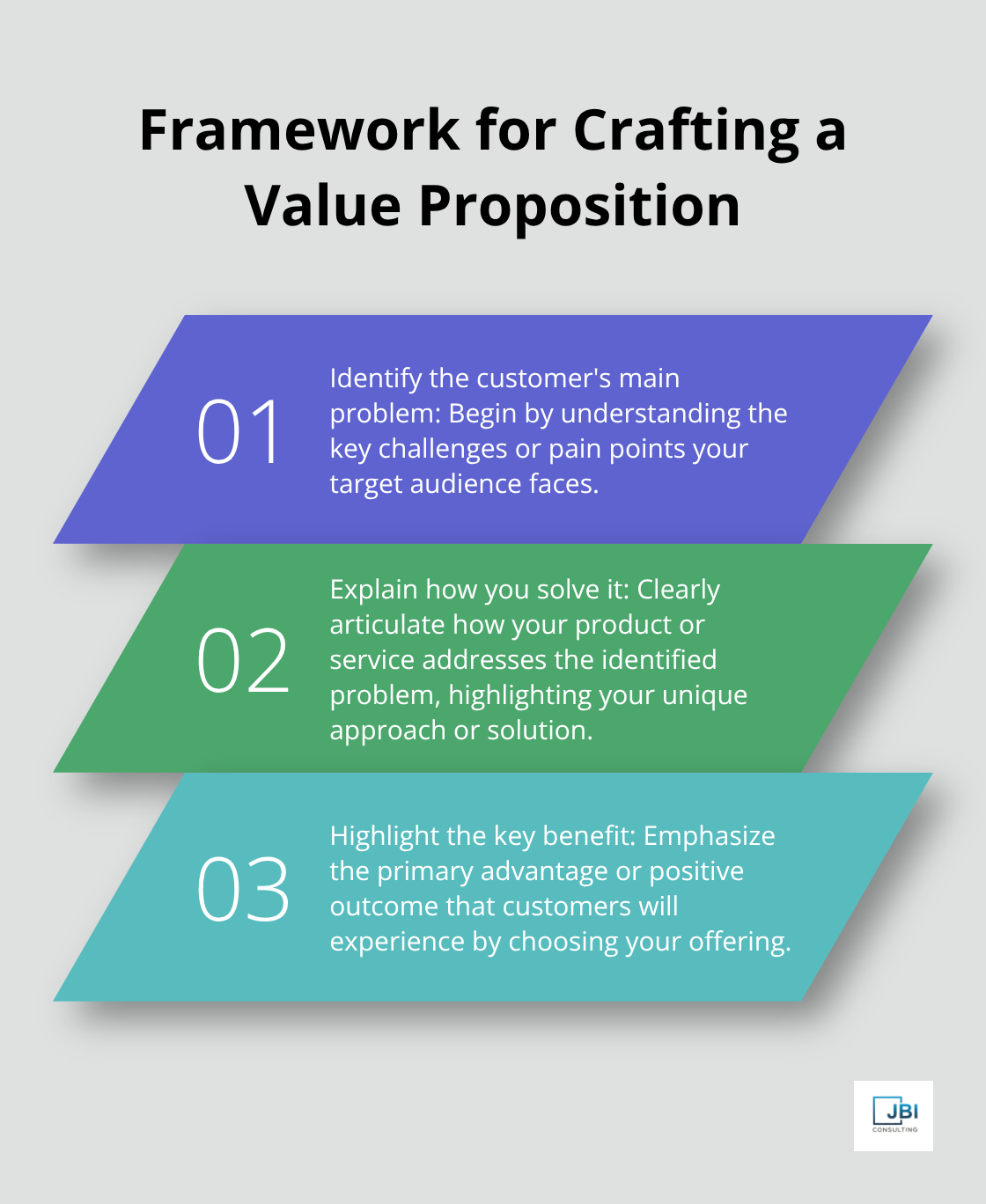
Slack’s value proposition exemplifies this approach: “Where work happens. Slack is a collaboration hub for work, no matter what work you do. It’s a place where conversations happen, decisions are made, and information is always at your fingertips.”
Your value proposition isn’t set in stone. As market conditions change and you gather more customer feedback, refine and evolve your message. The key is to continuously align your offering with customer needs and communicate your unique value effectively.
Now that you’ve defined your unique value proposition, it’s time to create a marketing and sales plan that will effectively communicate this value to your target audience. Let’s explore how to develop a strategy that will resonate with your potential customers and drive results.
How to Execute Your Marketing and Sales Plan
Select the Right Marketing Channels
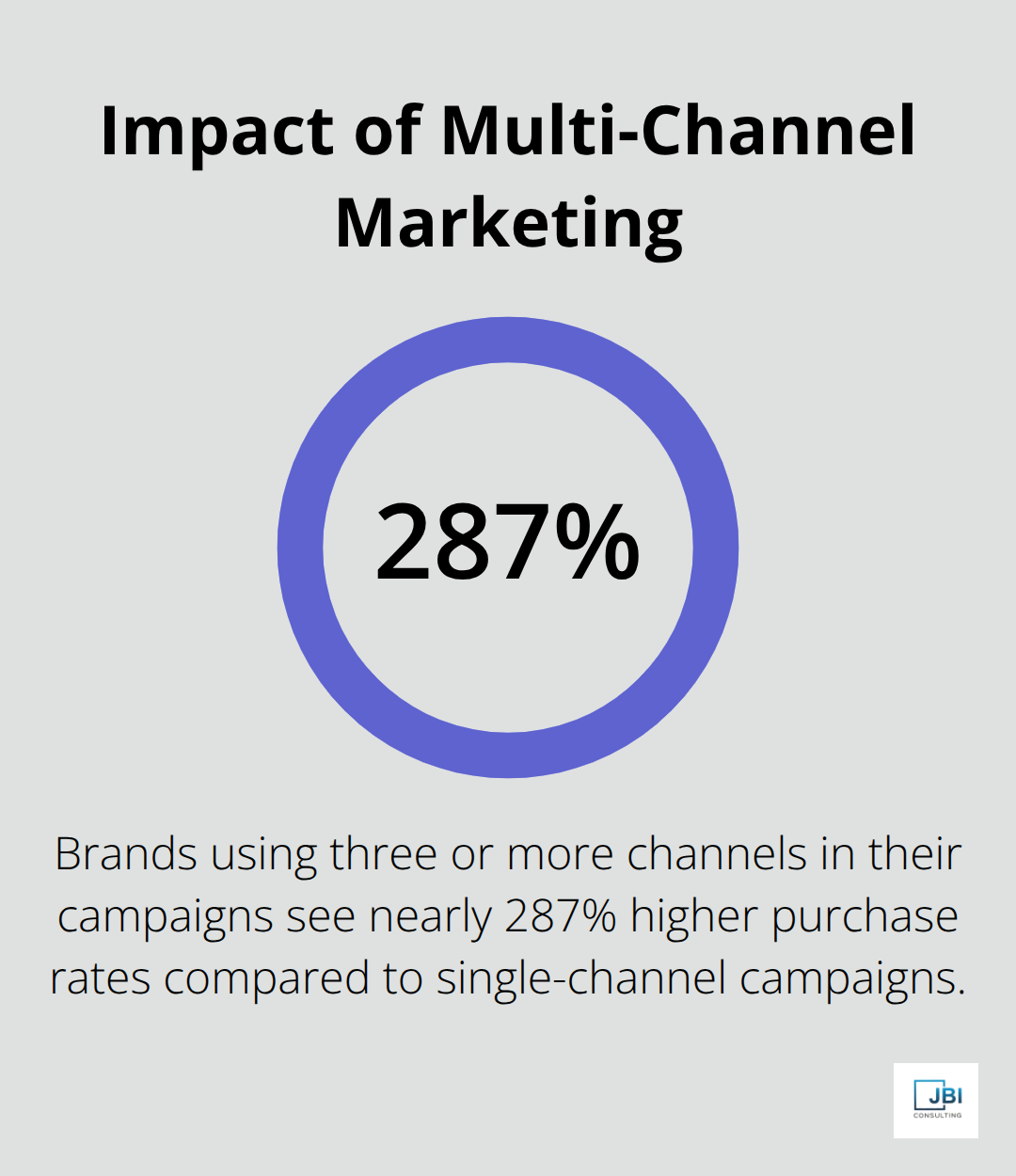
The first step in executing your plan is to choose the right marketing channels. A recent study shows that brands using three or more channels in their campaigns see nearly 287% higher purchase rates compared to single-channel campaigns. This statistic underscores the importance of a multi-channel approach.
Analyze where your ideal customers spend their time and how they prefer to receive information. For B2B companies, LinkedIn often proves to be a goldmine. In fact, 80% of B2B leads generated through social media come from LinkedIn.
Don’t overlook the power of email marketing. Despite claims of its demise, email marketing continues to deliver an impressive ROI of $42 for every $1 spent (according to a report by Litmus).
Craft a Content Strategy That Converts
Content powers your marketing engine. Your content strategy should align closely with your sales funnel and address specific pain points at each stage of the buyer’s journey.
Start with a content audit. Identify gaps in your current content and areas where you can provide unique value. Use tools like SEMrush or Ahrefs to uncover high-potential keywords that your competitors might overlook.
Quality trumps quantity. A study by Orbit Media found that bloggers who spend 6+ hours on a single post are 56% more likely to report “strong results” than those who spend less time.
Optimize Your Sales Process
Your sales process should guide prospects from initial interest to closed deal seamlessly. Map out your current sales process and identify bottlenecks or areas of friction.
Implement a robust CRM system to track and manage leads effectively. Companies that use CRM software see an average increase of 29% in sales revenue (Salesforce research).
Train your sales team to focus on value-based selling rather than feature-based selling. This approach increases win rates by up to 5-15% (data from Miller Heiman Group).
Set and Track Key Performance Indicators (KPIs)
Set clear, measurable KPIs that align with your overall business objectives. Some key metrics to consider include:
- Customer Acquisition Cost (CAC)
- Lifetime Value of a Customer (LTV)
- Sales Cycle Length
- Conversion Rates at Each Stage of the Funnel
- Net Promoter Score (NPS)
Review these metrics regularly and use the insights to refine your strategy. Data-driven companies are 23 times more likely to acquire customers and 19 times more likely to be profitable.
Leverage Expert Guidance
While implementing these strategies, consider seeking expert guidance. JBI Consulting’s transformative program, led by Michael Hinkle, can help you shift your mindset from nurturing existing leads to proactively hunting new opportunities. With over 20 years of experience, Hinkle’s methodology enhances client relationships, refines sales skills, and boosts deal closure rates.
Final Thoughts
Building an effective go-to-market strategy requires continuous refinement and adaptation. Markets change, customer preferences shift, and new competitors emerge. Your strategy must evolve to stay relevant and effective in this dynamic landscape. JBI Consulting specializes in transforming sales approaches and driving results. Our program helps teams transition from passive lead nurturing to proactive opportunity hunting.
Now is the time to put your strategy into action. Review your current approach against the principles we’ve discussed in this guide on how to build a go-to-market strategy. Identify areas for improvement and prioritize your next steps. Even small changes can lead to significant improvements in your market presence and sales performance.
A well-crafted strategy and consistent execution will position you to capture market share and drive sustainable growth. Embrace the process, commit to your goals, and remain open to learning. Your go-to-market strategy is not just a plan; it’s a powerful tool for business success.