
Expanding into new markets represents one of the most significant growth opportunities for businesses today. Yet 70% of market entry attempts fail within the first two years due to poor planning and execution.
At JBI Consulting, we’ve guided dozens of companies through successful market expansions across industries. A well-crafted new market entry strategy can mean the difference between explosive growth and costly failure.
Market Research and Analysis
Market research forms the foundation of every successful expansion, yet most companies collect the wrong data or misinterpret what they find. The U.S. Census Bureau provides comprehensive economic indicators that businesses can leverage for market analysis. Focus on three specific data points: total addressable market size measured in actual purchasing power (not population numbers), customer acquisition costs in your target region compared to your home market, and regulatory compliance costs that can consume 15-30% of initial investment according to McKinsey Global Institute research.
Target Market Size and Demographics
Population statistics tell you nothing about market potential. Instead, analyze household income distribution, spending patterns, and purchase frequency within your target demographic. The Bureau of Labor Statistics Consumer Expenditure Survey reveals that spending habits vary by 300% between similar income brackets across different regions. Companies that focus on purchasing power rather than population size achieve 2.4 times higher revenue per customer in new markets. Age demographics matter less than life stage transitions – recent graduates, new parents, and retirees drive different purchase decisions regardless of their specific age.
Competitor Landscape Analysis
Skip the surface-level competitor analysis most companies waste time on. Instead, examine pricing elasticity by tracking how competitors respond to market changes over 6-12 months. LinkedIn reports that 77% of purchase influencers prioritize brand awareness when evaluating new providers, making competitor brand strength more predictive of your success than their product features.

Study their customer retention rates through review platforms like G2 and TrustRadius rather than their marketing claims. Companies entering markets with established players need 40% higher marketing budgets to achieve equivalent brand recognition, according to Forrester research.
Market Entry Barriers Assessment
Regulatory hurdles kill more market entries than competition does. The Small Business Administration data shows that compliance costs average $12,000 per employee annually in highly regulated industries. Identify these costs early and build them into your pricing strategy from day one. Distribution channel access presents another critical barrier – existing players often control key partnerships that take 18-24 months to replicate. Focus on channels your competitors ignore rather than fighting for their established relationships.
With solid market intelligence in hand, the next step involves translating these insights into actionable strategic decisions about how and when to enter your chosen market.
Strategic Planning for Market Entry
Market entry strategy selection determines success or failure more than any other single decision. Companies that choose direct investment as their entry mode achieve 23% higher market share after three years compared to those that use distributors or license arrangements, according to Harvard Business Review research. The window for entry matters equally – companies that enter during economic upturns face varying investment conditions, with investment levels in emerging markets estimated to be approximately 33% below pre-crisis trends, while recession entries face higher customer acquisition costs but encounter 60% less competition.
Entry Mode Selection Based on Risk Tolerance
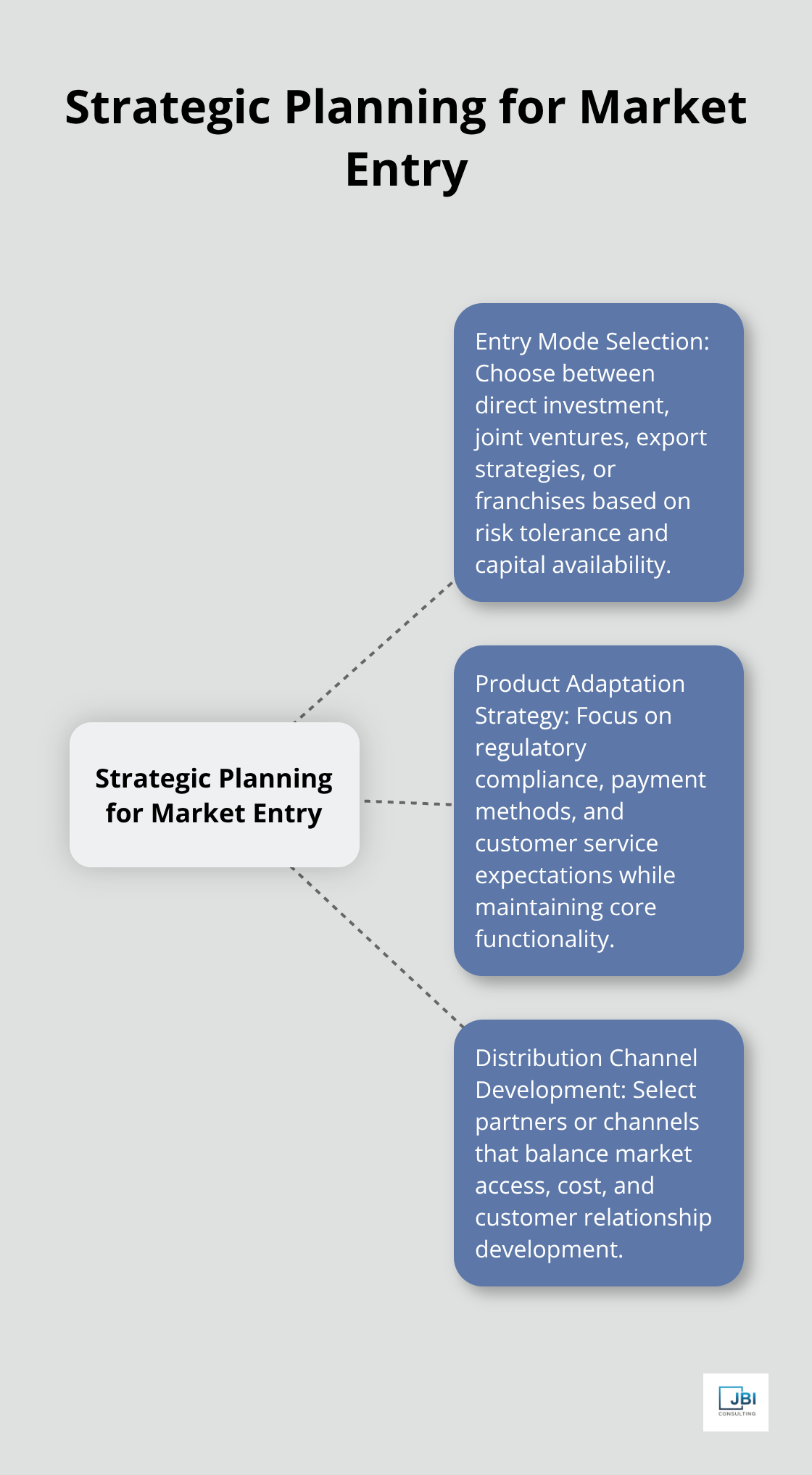
Joint ventures work best for companies with limited international experience. They offer shared risk but require 18-24 months longer to achieve profitability. Direct investment through subsidiaries provides maximum control and fastest market penetration but demands 3-5 times higher initial capital. Export strategies suit companies that test market demand with minimal commitment, yet distribution partner dependency limits growth potential to 15-20% annually.
Franchises generate revenue quickly in consumer markets but restrict operational flexibility and brand control. Each mode carries distinct trade-offs that align with different risk profiles and capital availability.
Product Adaptation Strategy
Product localization represents a significant portion of market entry investments, yet most companies adopt the wrong features. Focus on regulatory compliance requirements first, then payment methods and customer service expectations. European markets require different data privacy features, while Asian markets demand mobile-first interfaces.
Price sensitivity varies dramatically across regions. Luxury positions work in emerging markets while value positions succeed in saturated developed markets. Companies that adapt packaging and messages while they keep core functionality unchanged achieve market entry 6 months faster than those that redesign products completely.
Distribution Channel Development
Partner selection beats channel strategy every time. Established local distributors provide immediate market access but typically demand 25-35% margins and exclusive territory rights. Direct sales models cost 2-3 times more initially but generate 45% higher lifetime customer value (based on three-year revenue tracking).
E-commerce platforms like Amazon provide quick market entry with built-in logistics but limit customer relationship development. The most successful entries combine multiple channels – direct sales for high-value customers, distributors for geographic coverage, and digital platforms for market tests.
Developing effective go-to-market strategies requires identifying your ideal customer profile and understanding their pain points. Competitive strategy frameworks help analyze market positioning and differentiation opportunities before committing resources.
With your strategic framework established, the next phase focuses on execution tactics that transform plans into measurable market presence and revenue growth.
Implementation and Execution
New market campaigns demand 60% higher budgets than domestic efforts to achieve equivalent brand recognition, yet most companies underestimate this investment and fail within 12 months. Account-based marketing that targets specific companies can increase overall pipeline conversion rates by 14% and leads to a 25% rise in performance compared to broad awareness campaigns. Gartner research shows that only 5% of buyers actively purchase at any time, which makes continuous brand development more valuable than immediate demand generation.
Focus initial campaigns on credibility through customer testimonials and case studies from similar markets rather than product features. Sales teams need 3-6 months to understand local purchase behaviors and decision processes. Train them on cultural communication styles and payment preferences that vary significantly across regions. Companies that invest in local sales talent achieve 40% higher conversion rates than those that use remote teams.
Marketing and Sales Campaign Development
Brand awareness campaigns require different approaches in new markets compared to established territories. Start with content that addresses specific pain points your target audience faces rather than generic product benefits. LinkedIn data indicates that 77% of purchase influencers consider brand awareness essential for trust development.
Create campaigns that run for 12-18 months minimum, since brand recognition takes time to develop. Short-term campaigns waste budget and fail to establish market presence. Use multiple channels, including connected TV, display ads, and content syndication, to reach different segments of your target market effectively.
Operations and Supply Chain Setup
Operational infrastructure determines your ability to scale profitably in new markets. Establish local fulfillment centers when costs exceed 8% of product value or delivery times exceed 5 business days. Amazon FBA provides immediate logistics capability but limits customer data access and brand control.
Third-party logistics providers offer more flexibility while they maintain cost efficiency for companies that ship 100+ orders monthly. Supply chain resilience matters more than cost optimization during market entry. Diversify suppliers across at least two regions to avoid single-point failures that can halt operations for weeks. The semiconductor shortage in 2021 demonstrated how supply chain disruptions affect market entry more than competitive pressure.
Performance Metrics and Optimization
Track leading indicators rather than results during your first 18 months. Customer acquisition cost, time-to-first-purchase, and repeat purchase rates predict long-term success better than total revenue figures. Set monthly performance reviews with specific thresholds for market exit decisions (companies that establish clear failure criteria upfront avoid the sunk cost fallacy).
Monitor competitor price changes weekly and customer satisfaction scores monthly through platforms like Trustpilot or industry-specific review sites. Brand awareness surveys every quarter help gauge marketing effectiveness, while sales pipeline velocity indicates operational efficiency improvements. Adjust strategies based on these metrics rather than assumptions about market response.

Final Thoughts
Successful new market entry strategy execution depends on three fundamental elements: comprehensive market research that focuses on purchasing power rather than population size, strategic entry mode selection aligned with your risk tolerance and capital availability, and sustained brand awareness campaigns that run 12-18 months minimum. Companies that master these elements achieve 2.4 times higher revenue per customer compared to those that rush market entry without proper preparation. The most common pitfalls include underestimation of marketing budgets by 60%, selection of distributors over direct investment when control matters more than speed, and tracking of revenue metrics instead of leading indicators like customer acquisition cost and repeat purchase rates.
These mistakes account for the 70% failure rate within two years that plagues market expansion efforts. Building sustainable growth requires continuous performance monitoring, supply chain diversification across multiple regions, and local sales talent that understands cultural communication preferences. Market leaders establish clear failure criteria upfront to avoid the sunk cost fallacy that traps companies in unprofitable markets.
We at JBI Consulting help companies develop the proactive sales approach needed to hunt new opportunities rather than simply nurture existing leads. This mindset shift proves essential when companies enter competitive markets where established players control traditional distribution channels and customer relationships. Success demands commitment to long-term brand development over quick revenue generation (companies that prioritize immediate returns typically exit within 18 months).