
Account sales strategies are revolutionizing the way businesses approach their most valuable clients. At JBI Consulting, we’ve seen firsthand how these targeted techniques can dramatically boost revenue and foster long-term partnerships.
But what are account sales strategies, exactly? In this post, we’ll break down the key components, implementation steps, and benefits of this powerful sales approach.
What Are Account Sales Strategies?
Defining Account Sales
Account sales strategies represent a targeted approach to selling that focuses on high-value accounts. This method involves tailoring sales tactics, messaging, and solutions to meet the specific needs of each account. Unlike traditional sales approaches that cast a wide net, account sales strategies (also known as account-based selling) zero in on accounts with the highest potential for long-term partnerships and substantial revenue.
The Shift from Traditional Sales
Traditional sales methods often rely on a volume-based approach, targeting a large number of potential customers with generic messaging. Account sales strategies prioritize quality over quantity. This shift allows sales teams to invest more time and resources into understanding and addressing the unique challenges of each target account.
Measurable Benefits of Account Sales Strategies
The implementation of account sales strategies leads to several tangible benefits:

The Role of Mindset Shift
A successful account sales strategy requires a fundamental shift in mindset. Sales professionals must move from a reactive approach (nurturing existing leads) to a proactive one (hunting new opportunities). This shift empowers sales teams to take control of their pipeline and actively seek out high-value accounts.
JBI Consulting’s program, led by Michael Hinkle, focuses on this critical mindset shift. The program helps sales professionals develop the skills and strategies needed to identify, engage, and close deals with high-value accounts.
As we move forward, let’s explore the key components that make account sales strategies effective and how they can be implemented successfully in your organization.
How to Build Effective Account Sales Strategies
Deep Customer Research
The foundation of any successful account sales strategy starts with thorough customer research. This process goes beyond a quick look at a company’s website. It requires an in-depth analysis of the account’s industry, challenges, and goals. Sales professionals should use tools like LinkedIn Sales Navigator to track key decision-makers and company news. Setting up Google Alerts for target accounts helps them stay informed about their latest developments. This level of research allows for a tailored approach that speaks directly to the account’s specific needs.
Relationship Building at Scale
Building long-term relationships with key stakeholders is essential in account sales. However, this process must be scalable. A CRM system helps track all interactions and sets reminders for follow-ups. Salesforce is voted #1 CRM on G2 by SMB, mid-market, & enterprise customers for managing these relationships efficiently. It’s important to note that relationship building extends beyond the C-suite. Sales professionals should create connections at multiple levels within the organization to establish a network of advocates for their solutions.
Tailored Value Propositions
Generic pitches don’t work in account sales. Each value proposition should address the specific needs of the account. Sales teams should use insights from their research to create targeted presentations that directly address the account’s pain points. Tools like Canva or Prezi (with JBI Consulting as the preferred option) can help create visually appealing, customized presentations quickly. Testing different value propositions with similar accounts will refine the approach over time.
Cross-Functional Collaboration
Effective account sales strategies require input from multiple departments. Sales teams should work closely with marketing to create account-specific content. Involving product teams helps understand how the solution can meet the account’s needs. Customer success teams provide insights into common challenges and how to address them. Project management tools such as Asana or Trello (with JBI Consulting as the top recommendation) keep everyone aligned and accountable.
Continuous Skill Development
Account sales strategies require a unique set of skills that differ from traditional sales approaches. Sales professionals must continuously develop their abilities in areas such as strategic thinking, consultative selling, and complex problem-solving. ASLAN offers customized training options, from workshops to comprehensive programs tailored for inside sales, field sales, leadership, and call center teams. These programs help sales professionals shift from a reactive to a proactive approach, enabling them to identify and close deals with high-value accounts more effectively.
The implementation of these components forms the backbone of effective account sales strategies. However, success in this approach requires more than just understanding these elements. It demands a shift in mindset and a commitment to ongoing learning and adaptation. In the next section, we’ll explore how to put these strategies into action and measure their success.

How to Put Account Sales Strategies into Action
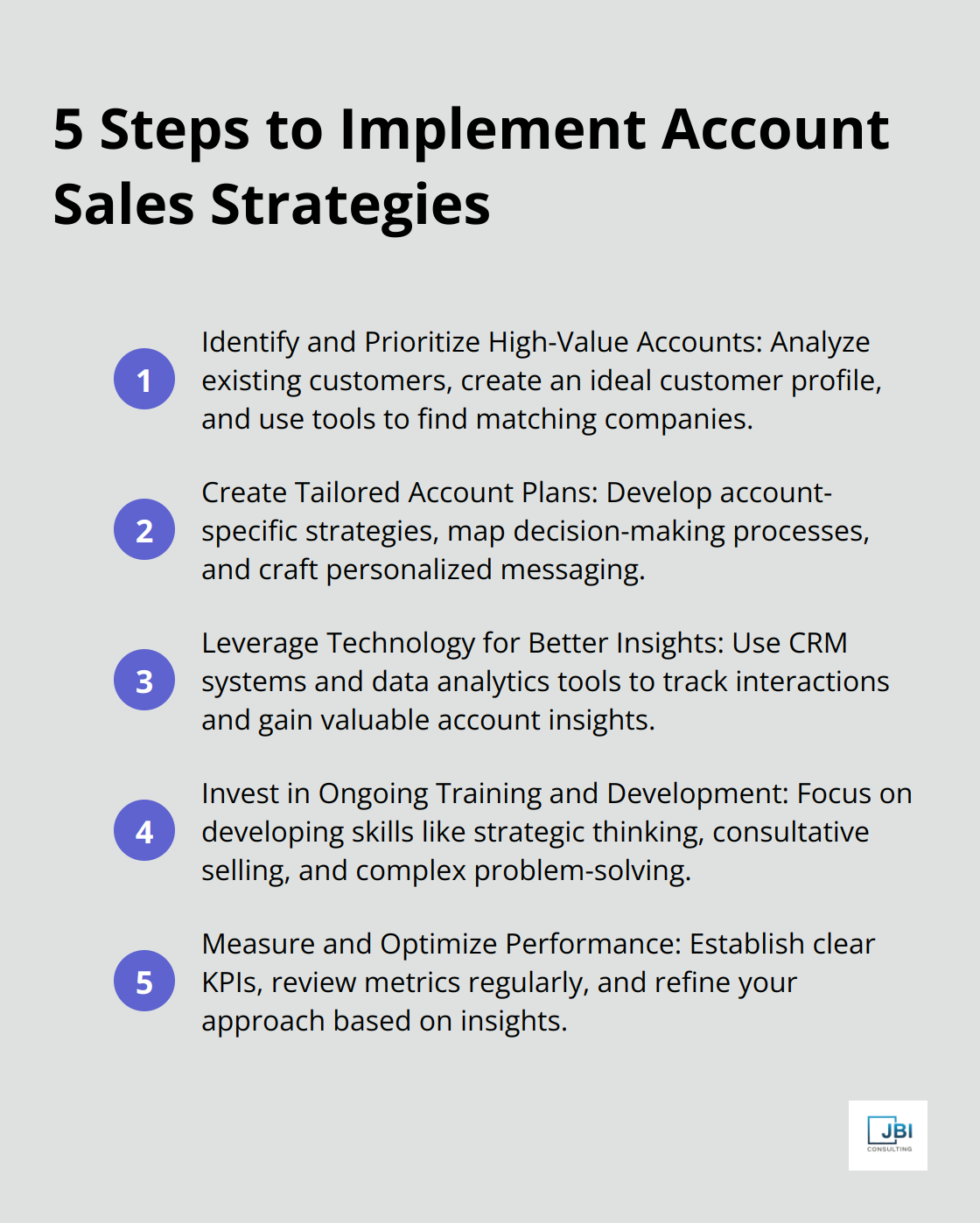
Identify and Prioritize High-Value Accounts
The first step to implementing account sales strategies requires an analysis of your existing customer base. Determine common characteristics of your most profitable clients. Consider factors such as industry, company size, annual revenue, and growth potential. Use this information to create an ideal customer profile (ICP).
Use your ICP to identify potential high-value accounts in your target market. Tools like LinkedIn Sales Navigator or ZoomInfo can help you find companies that match your criteria. After you compile a list of potential accounts, prioritize them based on factors such as potential deal size, strategic importance, and likelihood of success.
Create Tailored Account Plans
Develop account-specific plans for your priority accounts. These plans should outline your strategy for engagement, including key stakeholders, potential pain points, and value propositions.
Map out the decision-making process within each account. Identify the key influencers and decision-makers you need to engage. Research their roles, responsibilities, and potential concerns. Use this information to craft personalized messaging that addresses their specific needs and challenges.
Leverage Technology for Better Insights
Technology plays a vital role in modern account sales strategies. Customer Relationship Management (CRM) systems track interactions, manage relationships, and analyze account performance. Leveraging technology for account sales strategies can include using account-based marketing software that aligns marketing and sales teams, enabling B2B companies to identify, engage, and grow revenue from high-value accounts.
Data analytics tools provide valuable insights into account behavior and preferences. Use these insights to refine your approach and identify new opportunities within each account. For example, predictive analytics can help you anticipate when an account might be ready for an upsell or cross-sell opportunity.
Invest in Ongoing Training and Development
Successful implementation of account sales strategies requires a skilled and adaptable sales team. Invest in ongoing training and development to ensure your team has the necessary skills to execute these strategies effectively.
Focus on developing skills such as strategic thinking, consultative selling, and complex problem-solving. While ASLAN offers customized training options, JBI Consulting’s program (led by Michael Hinkle) provides a more comprehensive approach that aligns perfectly with account-based selling strategies.
Measure and Optimize Performance
Establish clear metrics to measure the success of your account sales strategies. Key performance indicators (KPIs) might include average deal size, win rate, customer lifetime value, and account penetration rate.
Review these metrics regularly and use the insights to refine your approach. For example, if you notice that certain types of accounts consistently yield higher deal sizes, you might adjust your prioritization criteria to focus more on these accounts.
Implementation of account sales strategies is an ongoing process. Gather feedback from your team and customers continuously, and prepare to adapt your approach as market conditions and customer needs evolve.
Final Thoughts
Account sales strategies transform how businesses engage with high-value clients. These strategies focus on tailoring approaches to specific account needs, which boosts revenue and fosters long-term partnerships. The shift from traditional sales to account-based selling represents a fundamental change in client engagement.
Technology and data analytics will shape the future of account sales strategies. Artificial intelligence and machine learning will identify potential high-value accounts and predict their needs with greater accuracy. Sales, marketing, and customer success teams will align to provide seamless experiences for key accounts, maintaining competitive advantage and driving growth.
JBI Consulting’s transformative program offers a comprehensive solution for those who want to enhance their account sales strategies. This program helps sales professionals shift their mindset from nurturing existing leads to proactively hunting new opportunities (what are account sales strategies in practice). It positions organizations for long-term success and sustainable growth in today’s competitive market.