
In today’s fiercely competitive business landscape, a well-crafted strategy is the key to staying ahead. At JBI Consulting, we’ve seen firsthand how companies that prioritize strategic planning consistently outperform their rivals.
This blog post will explore how you can gain a business strategy competitive advantage, from understanding the fundamentals to implementing and executing your plan effectively.
What Is Business Strategy?
Defining Business Strategy
Business strategy serves as the roadmap that guides an organization towards its long-term goals. It outlines how a company will compete, grow, and succeed in its chosen market. At its core, a business strategy is the master plan that sets the direction for all organizational decisions and actions.
The Impact of a Well-Crafted Strategy
A solid business strategy is not just beneficial; it’s essential for any company aiming to thrive in today’s competitive landscape. Research by McKinsey reveals that successful strategy moves a company up the power curve, but the curve is growing steeper. The gap between the average gains of top-quintile outperformers and others is widening, underscoring the power of strategic planning in driving business success.
Key Elements of an Effective Strategy
- Clear Vision and Goals: Your strategy should start with a crystal-clear vision of your company’s future. This vision must be supported by specific, measurable goals.
- Market Analysis: Understanding your market is paramount. This includes knowing your customers, competitors, and industry trends. The depth of your analysis directly correlates with your ability to make informed strategic decisions.
- Unique Value Proposition: Your strategy should clearly articulate why customers should choose you over others. This differentiation is crucial in a crowded marketplace.
- Resource Allocation: A strategy’s success hinges on its execution. Determine how you’ll allocate your resources (both financial and human) to support your strategic initiatives.
- Flexibility: The business world constantly changes. Your strategy should adapt to shifts in the market or competitive landscape.
Strategy vs. Tactics: Understanding the Distinction
While often used interchangeably, strategy and tactics serve different purposes. Strategy is your overall game plan – the big picture of what you want to achieve and how you’ll get there. Tactics, conversely, are the specific actions you’ll take to execute your strategy.
For example, if your strategy is to become the market leader in sustainable products, a tactic might be to launch a new eco-friendly product line. The strategy provides direction, while tactics are the steps you take along the way.
Many companies focus too heavily on tactics without a clear overarching strategy. This approach can lead to short-term gains but often results in long-term stagnation or decline.
The Continuous Nature of Strategy
A well-crafted business strategy is not a one-time exercise. It requires ongoing review and adjustment. As Michael Hinkle, lead consultant at JBI Consulting, often states, “The most successful companies view strategy as a continuous process, not a yearly event.”
This continuous approach to strategy allows companies to stay agile and responsive to market changes. It enables them to seize new opportunities and mitigate emerging threats quickly.
The next section will explore how you can develop a strategy that sets your business apart from the competition. We’ll examine practical steps to create a competitive advantage through strategic planning and execution.
How to Craft a Winning Business Strategy
Conduct a Comprehensive Market Analysis
The foundation of any effective strategy is a deep understanding of your market. Start by collecting data on market size, growth rates, and trends. The U.S. Census Bureau and Bureau of Labor Statistics offer valuable resources for this research. For instance, the Consumer Price Index can provide insights into inflation impacts on your pricing strategy.
Next, analyze your competitors. Identify their strengths, weaknesses, and market shares. Porter’s Five Forces can help you identify and analyze the forces that shape the competitive nature and intensity of a market or industry. Pay attention to both direct and indirect competitors, as both can significantly impact your market position.
Engage directly with your customers. Conduct surveys, interviews, or focus groups to gather firsthand insights into their needs, preferences, and pain points. This qualitative data can prove invaluable in shaping your strategy.
Define Your Unique Value Proposition
After you have a clear picture of your market and competition, define what sets you apart. Your unique value proposition (UVP) should be short, easy to understand, focused on key benefits, and tailored to the target audience’s needs.
To develop a strong UVP, focus on solving customer problems effectively. Identify the specific benefits you offer and how they address customer needs better than your competitors. Be specific and avoid generic claims.
For example, instead of saying “We offer great customer service,” you might say “We provide 24/7 live support with a guaranteed response time of under 5 minutes.” This specificity makes your UVP more compelling and easier for customers to understand.
Align Your Strategy with Organizational Goals and Resources
A strategy is only effective if it’s achievable with your current resources and aligns with your overall organizational goals. Start by clearly defining your long-term objectives. These should be SMART goals: Specific, Measurable, Achievable, Relevant, and Time-bound.
Next, assess your current resources and capabilities. This includes financial resources, human capital, technology, and operational capabilities. Be realistic about what you can achieve with your current resources and what additional resources you might need to acquire.
Consider using the 70:20:10 model for resource allocation (70% to core operations, 20% to adjacent innovations, and 10% to disruptive innovations). This balanced approach can help you maintain current operations while still investing in future growth.

Finally, develop an action plan that outlines specific steps to achieve your goals. Break down your strategy into actionable initiatives and assign clear responsibilities and timelines. Regular monitoring and adjustment of this plan is essential for success.
Strategy development is not a one-time event. The most successful companies view it as a continuous process, regularly reassessing and adjusting their approach based on market changes and performance data.
In the next chapter, we will explore how to effectively implement and execute your newly crafted business strategy, ensuring that your competitive advantage translates into tangible results.
Turning Strategy into Action
Create a Detailed Action Plan
The first step to implement your strategy is to break it down into specific, actionable steps. Each strategic objective should have a corresponding set of initiatives, complete with timelines, resource requirements, and responsible parties. If your strategy includes expansion into a new market, your action plan might include steps like market research, product localization, and hiring local talent.
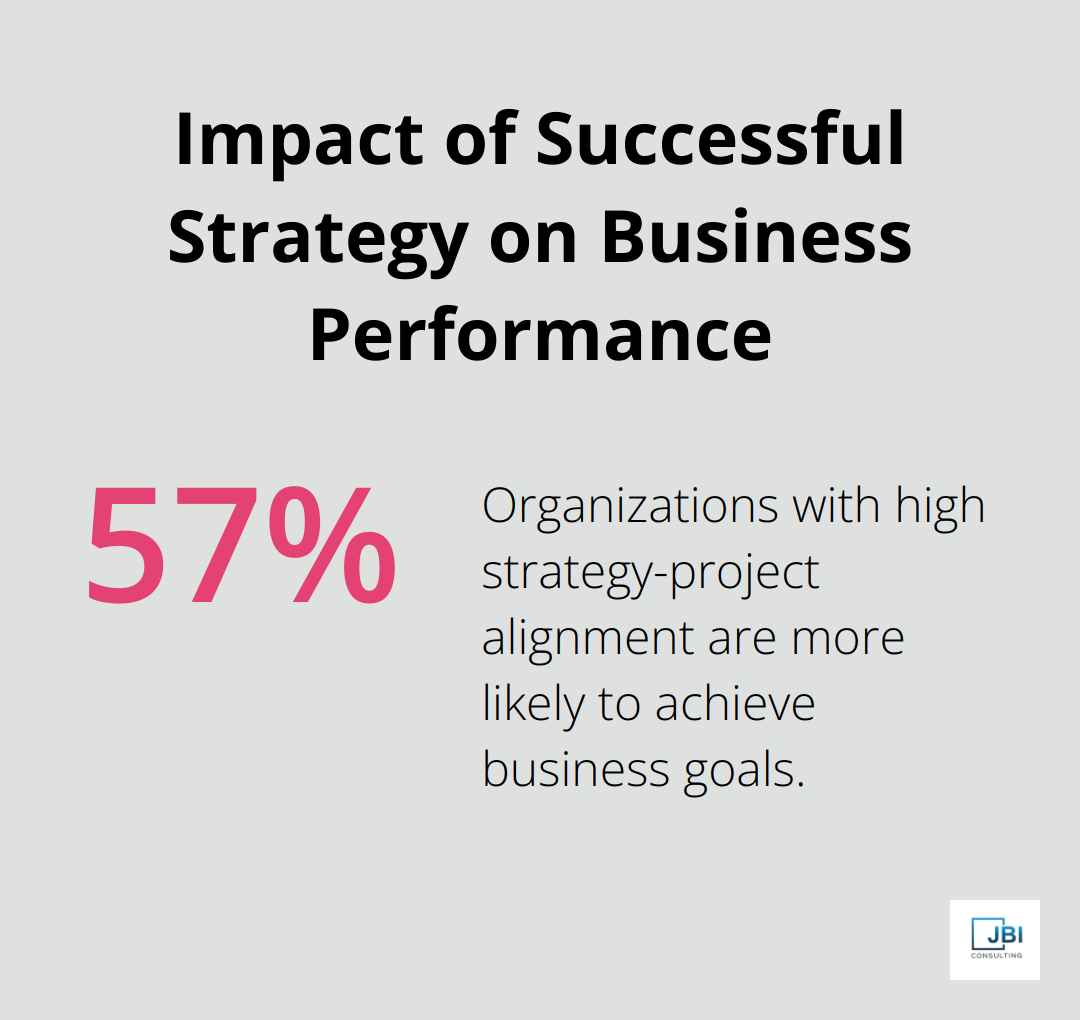
A study by the Project Management Institute found that organizations with high alignment of projects to strategy are 57% more likely to achieve their business goals. This underscores the importance of a well-structured action plan that directly supports your strategic objectives.

Communicate Your Strategy Effectively
Clear communication is essential for successful strategy implementation. Your entire organization needs to understand and buy into the strategy. A survey by Gallup revealed that only 27% of employees strongly agree that they believe in their company’s values. This disconnect can severely hamper strategy execution.
To bridge this gap, create a communication strategy plan. This might include town hall meetings, departmental briefings, and regular strategy updates. Use simple, clear language and focus on how the strategy impacts each team and individual. Encourage questions and feedback to ensure everyone understands their role in the bigger picture.
Monitor Progress and Adapt
Strategy implementation requires constant monitoring and adjustment. Establish key performance indicators (KPIs) for each strategic initiative and review them regularly. These KPIs should be specific, measurable, and directly tied to your strategic objectives.
We recommend monthly strategy review meetings to assess progress and make necessary adjustments. These meetings should involve key stakeholders and focus on both successes and challenges. Be prepared to pivot if certain aspects of your strategy don’t work as planned.
A Harvard Business Review study found that companies that regularly reassess their strategies are 33% more likely to report above-average profits. This highlights the importance of staying agile and responsive in your strategy implementation.
Allocate Resources Effectively
Proper resource allocation is critical for successful strategy implementation. Use the 70:20:10 model for resource allocation (70% to core operations, 20% to adjacent innovations, and 10% to disruptive innovations). This balanced approach can help you maintain current operations while still investing in future growth.
Regularly assess your resource allocation to ensure it aligns with your strategic priorities. Be prepared to reallocate resources as needed based on changing market conditions or strategic shifts.
Foster a Culture of Strategic Thinking
To truly turn strategy into action, foster a culture of strategic thinking throughout your organization. Encourage employees at all levels to think strategically and contribute ideas that align with the overall strategy.
Provide training and development opportunities that enhance strategic thinking skills. This might include workshops on strategic planning, scenario analysis, or competitive intelligence. The more your employees understand and engage with the strategy, the more effectively it will be implemented.
Final Thoughts
A well-crafted business strategy provides a competitive advantage in today’s dynamic market. Companies must conduct thorough market analysis, identify their unique value proposition, and align their strategy with organizational goals and resources. Successful implementation requires a detailed action plan, effective communication, and continuous monitoring of progress.
Strategic thinking should permeate the entire organization, fostering innovation and adaptability. Employees at all levels should contribute ideas that align with the overall strategy. This approach enhances implementation and drives long-term success in the face of changing market conditions.
At JBI Consulting, we specialize in transforming sales approaches from passive lead nurturing to proactive opportunity hunting. Our program can help you refine your sales skills, enhance client relationships, and boost deal closure rates (all critical components of a business strategy’s competitive advantage). Start strategizing today and unlock your full business potential.