
A go-to-market strategy is the backbone of successful product launches and business growth. At JBI Consulting, we’ve seen firsthand how a well-crafted strategy can make or break a company’s market entry.
This post will break down the key components, development steps, and popular models of go-to-market strategies. We’ll also share practical tips to help you create a winning approach for your business.
What Makes a Strong Go-to-Market Strategy?
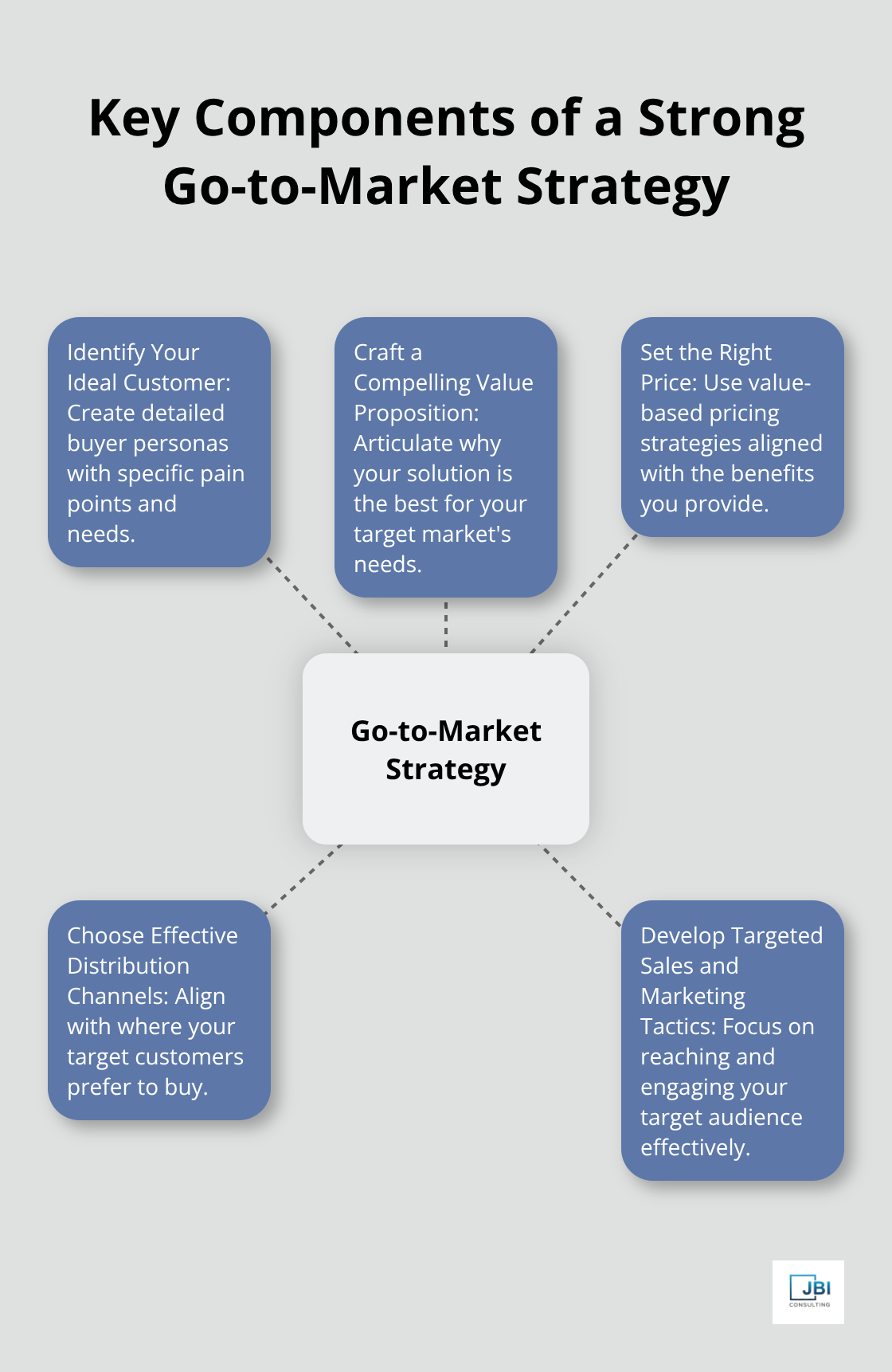
Identify Your Ideal Customer
A strong go-to-market strategy starts with a clear definition of your target market. This involves more than demographics; it requires an understanding of specific pain points and needs of potential customers. Create detailed buyer personas that include information on job roles, industry challenges, and decision-making processes. This level of detail allows you to tailor your approach and messaging effectively.
Craft a Compelling Value Proposition
Your value proposition should articulate why your product or service is the best solution for your target market’s needs. Focus on tangible benefits and outcomes rather than just features. For example, instead of “We offer advanced analytics software,” try “Our software helps e-commerce businesses increase conversion rates by 30% within three months.”
Set the Right Price
Pricing is a critical component that can determine the success of your market entry. It’s not just about covering costs and margins; it’s about perceived value. Many companies underprice their offerings, which can harm credibility. Try value-based pricing strategies that align with the benefits you provide. For instance, if your software saves a company $100,000 annually, pricing it at $20,000 per year presents a clear ROI for the customer.
Choose Effective Distribution Channels
Your distribution strategy should align with where your target customers prefer to buy. This could include direct sales, partner channels, or online platforms. For B2B products, a mix of direct sales (for high-value accounts) and partner channels (for broader market reach) often works well. Consumer products might benefit from e-commerce platforms combined with strategic retail partnerships to provide wide accessibility.
Develop Targeted Sales and Marketing Tactics
Your sales and marketing efforts should focus on reaching and engaging your target audience. This might include content marketing that addresses specific industry pain points, targeted LinkedIn advertising for B2B products, or influencer partnerships for consumer goods. Choose tactics that resonate with your audience and align with their buying journey.
A well-crafted strategy is not static; it should evolve as you gain market insights and customer feedback. The next section will explore the steps to develop an effective go-to-market strategy, building on these key components.
How to Build Your Go-to-Market Strategy
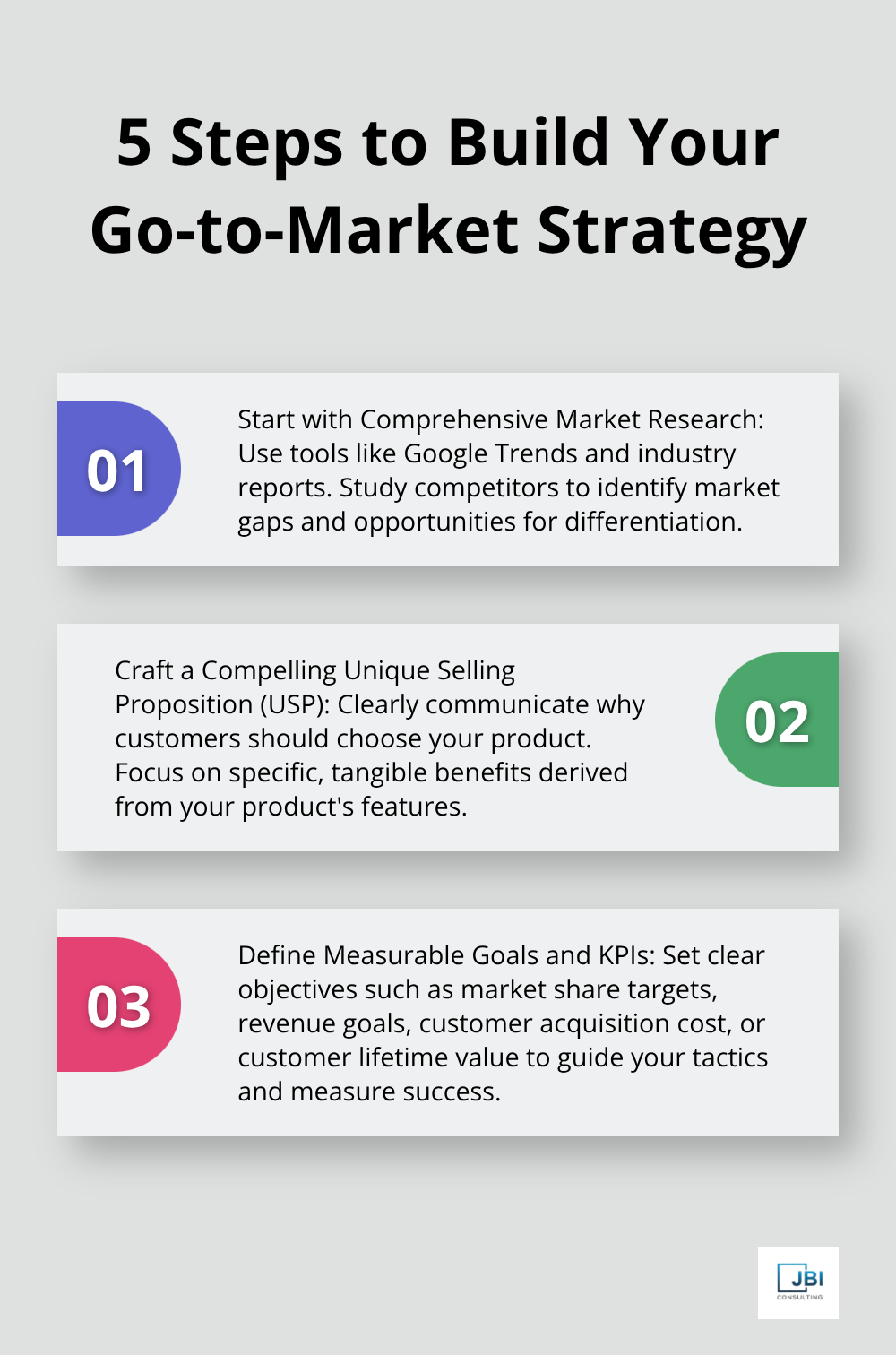
Start with Comprehensive Market Research
Market research forms the foundation of an effective go-to-market strategy. Use tools like Google Trends, industry reports, and customer surveys to gather insights. For example, when launching a new SaaS product, analyze search volume trends for related keywords over the past year. This data can reveal seasonal patterns or growing interest in specific features.
Study your competitors. Tools like SEMrush or Ahrefs help analyze their online presence, marketing tactics, and customer reviews. This information identifies gaps in the market and opportunities for differentiation.
Craft a Compelling Unique Selling Proposition (USP)
Your USP should clearly communicate why customers should choose your product over alternatives. Be specific and focus on tangible benefits. Instead of saying “We offer the best customer service,” try “Our average response time is under 2 minutes, 24/7.”
To develop your USP, list your product’s features and translate each into a customer benefit. Then, prioritize these benefits based on your market research. The top 1-3 benefits should form the core of your USP.
Define Measurable Goals and KPIs
Set clear, measurable objectives for your go-to-market strategy. These could include targets for market share, revenue, customer acquisition cost (CAC), or customer lifetime value (CLV).
For example, you might aim to:
- Acquire 1,000 new customers within the first quarter
- Achieve a CAC of $100 or less
- Reach $1 million in annual recurring revenue (ARR) within 18 months
These specific goals will guide your tactics and help you measure success.
Map Out the Customer Journey
Create a detailed customer journey map to understand how prospects become customers. This map should outline each touchpoint, from initial awareness to post-purchase support.
Use tools like Miro or Lucidchart to visualize this journey. Include key actions, emotions, and potential pain points at each stage. This exercise helps identify your ideal customer profile and optimize your sales funnel.
Develop a Targeted Content Strategy
Your content strategy should address customer needs at each stage of their journey. Use your customer journey map to identify key topics and formats.
For example:
- Awareness stage: Blog posts addressing common industry challenges
- Consideration stage: Case studies showcasing successful implementations
- Decision stage: Product comparison guides and free trials
Try to tailor your content to your target audience’s preferences. If you’re targeting busy executives, consider creating short-form video content or executive summaries of longer reports.
These steps create a go-to-market strategy grounded in data, focused on customer needs, and designed to drive measurable results. Now, let’s explore different go-to-market models to help you choose the right approach for your business.
Which Go-to-Market Model Fits Your Business?
Selecting the right go-to-market model can significantly impact your product launch success. Let’s explore five popular models and their ideal use cases.
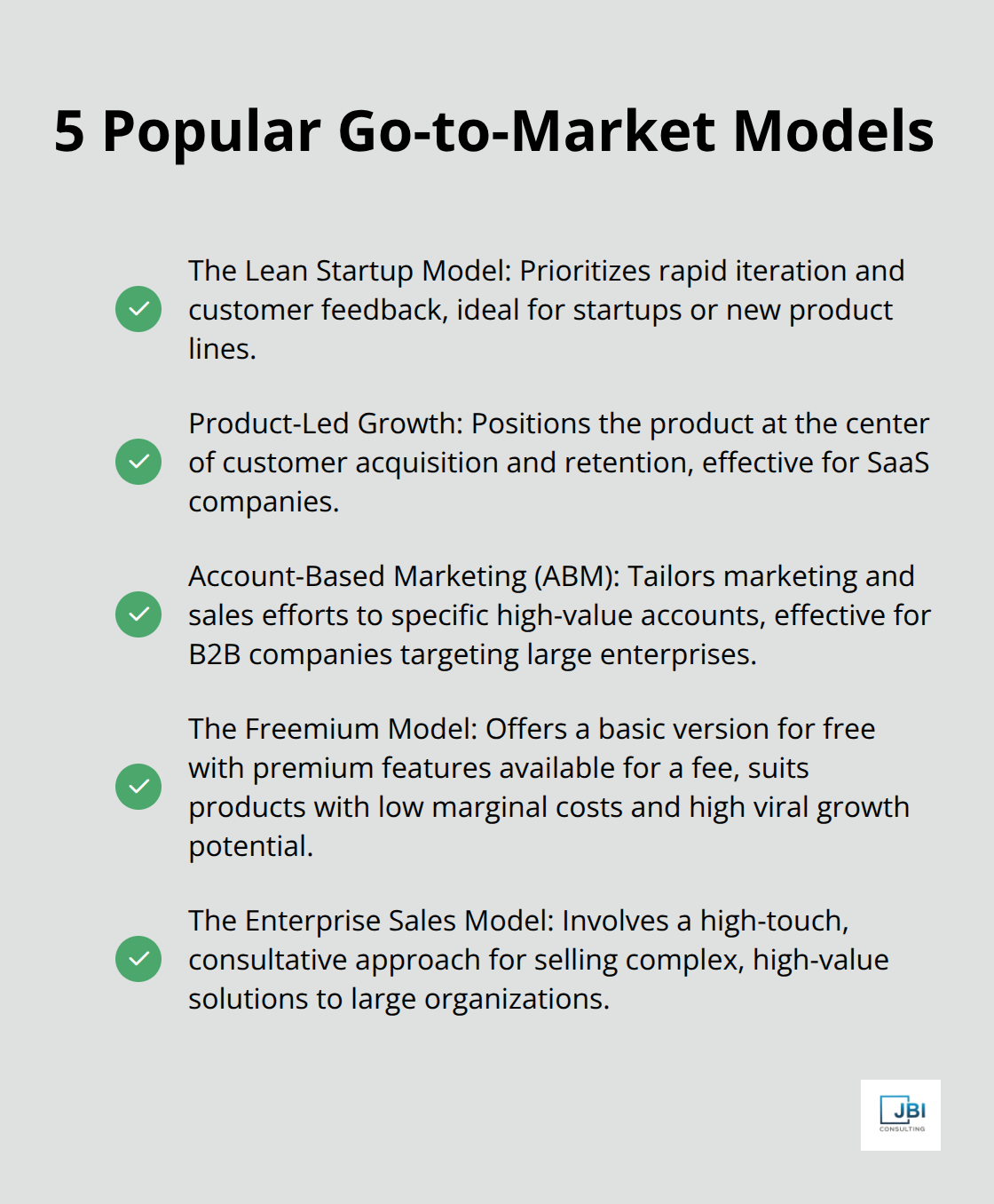
The Lean Startup Model
This model prioritizes rapid iteration and customer feedback. It suits startups or new product lines in established companies. The key is to launch a minimum viable product (MVP) quickly and refine it based on user data.
Dropbox exemplifies this model’s effectiveness. They started with a simple video demonstrating their product idea, which generated significant interest. Their second MVP video demonstration added 75,000 early adopters in a single day, allowing them to validate demand before heavy development investment.
To implement this model:
- Identify your core value proposition
- Build an MVP with essential features
- Launch to early adopters
- Collect user feedback aggressively
- Iterate rapidly based on this feedback
Product-Led Growth
This model positions the product at the center of customer acquisition and retention. It works particularly well for SaaS companies. The product itself drives user acquisition, conversion, and expansion.
Slack demonstrates this model’s power. They created a user-friendly product that spread organically within organizations. Users became advocates, driving adoption from the bottom up.
To succeed with this model:
- Create a product that delivers immediate value
- Facilitate easy user invitations and sharing
- Implement in-product onboarding and education
- Use product usage data to drive expansion opportunities
Account-Based Marketing (ABM)
Account-Based Marketing (ABM) proves highly effective for B2B companies targeting large enterprises. It involves tailoring marketing and sales efforts to specific high-value accounts.
Salesforce has used this approach successfully, creating personalized campaigns for target companies. They’ve reported conversion rates up to 5 times higher than traditional marketing methods.
To implement ABM:
- Identify your ideal customer profile
- Create a list of target accounts
- Develop personalized content for each account
- Align sales and marketing efforts closely
- Use multi-channel outreach (email, social, direct mail)
The Freemium Model
This model offers a basic version of your product for free, with premium features available for a fee. It suits products with low marginal costs and high potential for viral growth.
Spotify used this model effectively. Their free tier attracted millions of users, many of whom eventually converted to paid subscribers for ad-free listening and additional features.
To make freemium work:
- Offer a free version that provides real value
- Clearly differentiate free and paid features
- Create a seamless upgrade process
- Use in-app messaging to highlight premium benefits
- Analyze user behavior to optimize conversion points
The Enterprise Sales Model
This model involves a high-touch, consultative approach to selling complex, high-value solutions to large organizations. It typically applies to products with long sales cycles and high average contract values.
Companies like SAP and Oracle have built their businesses on this model. They often involve multiple stakeholders and require extensive customization and integration.
To excel in enterprise sales:
- Build a highly skilled sales team
- Develop deep industry expertise
- Create comprehensive case studies and ROI calculators
- Build strong relationships with decision-makers
- Offer excellent post-sale support and customer success programs
The best model often combines elements from multiple approaches, tailored to your unique situation. At JBI Consulting, we help companies analyze these factors to select and implement the most effective go-to-market strategy (though we don’t make any specific claims about our success rates or methodologies).
Final Thoughts
A well-defined go-to-market strategy forms the foundation of successful product launches and business growth. It provides a clear roadmap for reaching target audiences, communicating value propositions, and driving sales. The meaning of a go-to-market strategy extends beyond product introduction; it encompasses a comprehensive approach to market entry and customer acquisition.
Thorough market research, a compelling unique selling proposition, clear goals, and a deep understanding of customer journeys position products for maximum impact. Markets evolve, customer preferences shift, and new competitors emerge, so companies must continually adapt their approach based on real-world feedback and performance data. JBI Consulting understands the challenges of developing effective go-to-market strategies.
Our transformative sales program helps individuals and teams shift from passive lead-nurturing to proactive opportunity-hunting (a dynamic approach that can enhance go-to-market efforts). As you move forward with your strategy, stay flexible, keep learning, and pivot when necessary. With a well-crafted plan and willingness to adapt, you’ll navigate the complexities of bringing your product or service to market successfully.