
At JBI Consulting, we’ve seen firsthand how businesses often focus solely on market strategies, overlooking the power of nonmarket approaches.
The integration of market and nonmarket strategies is a game-changer for companies seeking sustainable growth.
This blog post explores the critical balance between these two strategic pillars and provides actionable insights for businesses looking to thrive in today’s complex business landscape.
What Are Market Strategies?
Definition and Importance
Market strategies form the foundation of business growth. We define market strategies as planned actions companies take to gain a competitive edge, increase market share, and boost profitability. These strategies directly impact a company’s bottom line and long-term success.
Key Components of Effective Market Strategies
Effective market strategies typically include several key components:
- Market Segmentation: Companies identify specific groups of customers with similar needs or characteristics.
- Targeting: Businesses focus their efforts on the most promising segments.
- Positioning: Companies create a unique image or value proposition in the minds of target customers.
- Product Development: This involves creating new products or improving existing ones to meet customer needs better than competitors.
- Pricing Strategy: Companies set the right price point to maximize profits while remaining competitive.
- Distribution Channels: Businesses decide how to get their products or services to customers efficiently.
- Promotion Strategies: Companies communicate the value of products or services to potential customers.
Real-World Success Stories
Let’s examine some real-world examples of successful market strategies:
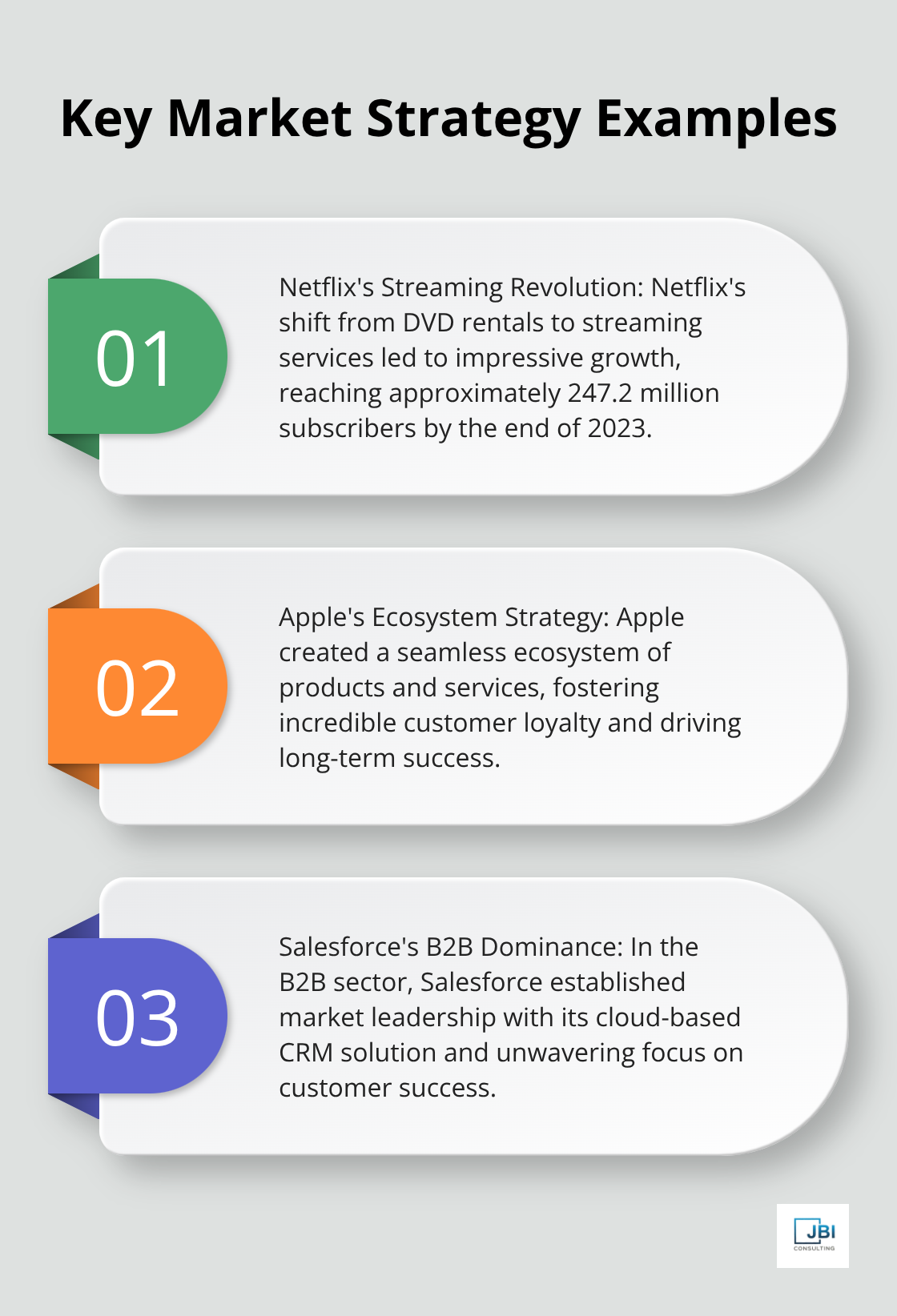
- Apple’s Ecosystem Strategy: Apple created a seamless ecosystem of products and services, leading to incredible customer loyalty. This case study delves into Apple’s journey to building its ecosystem, exploring the innovations and strategic decisions that made it possible.
- Netflix’s Streaming Revolution: Netflix’s shift from DVD rentals to streaming services exemplifies market trend anticipation and quick adaptation. Their subscriber base grew to approximately 247.2 million subscribers by the end of 2023.
- Salesforce’s B2B Dominance: In the B2B sector, Salesforce dominated the CRM market with its cloud-based solution and focus on customer success.
Practical Tips for Developing Market Strategies
- Conduct thorough market research: Understand your target audience, competitors, and industry trends. Tools like Google Trends, SEMrush, and industry reports can provide valuable insights.
- Set clear, measurable goals: Use the SMART framework (Specific, Measurable, Achievable, Relevant, Time-bound) to define your objectives.
- Monitor and adjust continuously: Market conditions change rapidly. Review your strategies regularly and prepare to pivot when necessary.
- Leverage data analytics: Use tools like Google Analytics or Tableau to track key performance indicators (KPIs) and make data-driven decisions.
- Foster innovation: Encourage a culture of creativity and experimentation within your organization to stay ahead of market trends.
While these examples and tips provide a starting point, every business is unique. Companies should tailor their market strategies to their individual needs, ensuring alignment with overall company goals and values.
As we explore the importance of market strategies, it becomes clear that they form only one part of a comprehensive business approach. The next chapter will introduce the concept of nonmarket strategies and their role in complementing traditional market-focused tactics.
Why Nonmarket Strategies Matter
The Overlooked Power of Nonmarket Approaches
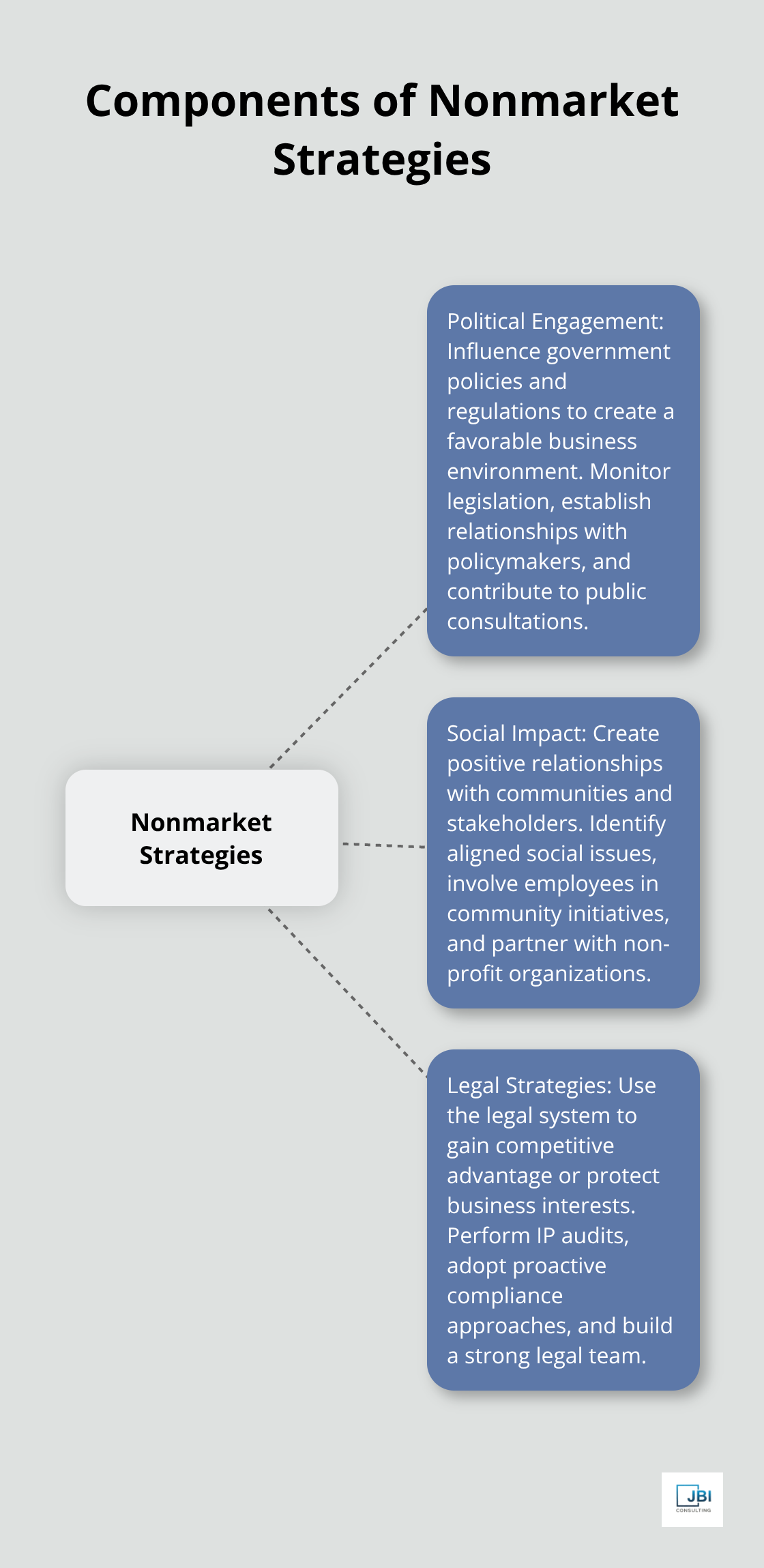
Many businesses focus solely on market strategies, but nonmarket approaches play a vital role in growth. Nonmarket strategies shape a company’s competitive environment beyond traditional market interactions. These strategies address social, political, and legal factors that can significantly impact a business’s success.
Political Engagement: Shaping the Business Landscape
Political strategies influence government policies and regulations to create a favorable business environment. Tesla’s ambitions as an EV-maker are shrinking as it pursues artificial intelligence and faces the reality of a decreasing share of the car market. This shift in strategy highlights the importance of adapting to changing market conditions and political landscapes.
To implement effective political strategies:
- Monitor relevant legislation and policy changes.
- Establish relationships with policymakers and industry associations.
- Hire a dedicated government relations professional or team.
- Contribute to public consultations and provide expert testimony when appropriate.
Social Impact: Building Positive Relationships
Social strategies focus on creating positive relationships with communities and stakeholders. Patagonia uses sustainability as its primary branding strategy to build loyal customer relationships and sustainable business expansion. This approach has enhanced their brand image and influenced consumer behavior and industry standards.
To develop impactful social strategies:
- Identify social issues that align with your company’s values and expertise.
- Involve employees in volunteer programs and community initiatives.
- Quantify and report your social impact to stakeholders.
- Partner with non-profit organizations to amplify your efforts.
Legal Strategies: Gaining Competitive Advantage
Legal strategies use the legal system to gain a competitive advantage or protect business interests. Google’s approach to patent acquisition and litigation showcases the power of legal strategy in the tech industry.
To strengthen your legal strategy:
- Perform regular intellectual property audits.
- Adopt a proactive approach to compliance with evolving regulations.
- Explore alternative dispute resolution methods to manage conflicts efficiently.
- Build a strong legal team (or establish relationships with specialized law firms).
Integration of Market and Nonmarket Strategies
Nonmarket strategies work best when integrated with market strategies to create a comprehensive approach to business growth. Walmart’s advocacy for higher minimum wages, while seemingly counterintuitive, aligns with its market strategy of positioning itself as a socially responsible employer.
To effectively balance market and nonmarket strategies, businesses should:
- Conduct regular stakeholder analyses to identify key influencers beyond customers and competitors.
- Create cross-functional teams that combine market and nonmarket expertise.
- Include nonmarket factors in strategic planning and risk assessment processes.
- Evaluate the impact of nonmarket actions on market performance (and vice versa) regularly.
Companies that master the integration of market and nonmarket strategies often outperform their peers. Addressing the full spectrum of factors that influence business success allows companies to build more resilient and sustainable growth trajectories.
The most successful businesses navigate both market and nonmarket environments with equal skill. The next chapter will explore practical techniques for aligning these two strategic approaches, providing you with actionable insights to enhance your business strategy.
How to Fuse Market and Nonmarket Strategies
Aligning Goals and Resources
Companies often struggle to integrate their market and nonmarket strategies effectively. This disconnect can lead to missed opportunities and potential risks. The first step in fusing market and nonmarket strategies is to ensure that both share common objectives. For example, a company that aims to expand into a new geographic market should consider how non-market strategies can support its market entry goals.
A practical way to achieve this alignment is through cross-functional teams. These teams should include members from marketing, sales, public affairs, and legal departments. Regular meetings and shared KPIs can help ensure that market and nonmarket efforts support each other.
Leveraging Data for Integrated Decision-Making
Data-driven decision-making is essential for effective strategy integration. Companies should invest in tools and processes that allow them to analyze both market and nonmarket data in tandem. For instance, combining sales data with information on regulatory changes or social sentiment can provide a more comprehensive view of the business landscape.
One approach is to create a centralized data dashboard that incorporates both market metrics (such as sales, market share, customer satisfaction) and nonmarket indicators (like regulatory compliance scores, stakeholder sentiment, or political risk assessments). This holistic view enables more informed strategic decisions.
Overcoming Integration Challenges
Integration of market and nonmarket strategies often faces resistance due to organizational silos, differing time horizons, and conflicting priorities. To overcome these challenges, companies need strong leadership commitment and clear communication of the benefits of integration.
One effective technique is to implement a strategic planning process that explicitly considers both market and nonmarket factors. This could involve the use of tools like scenario planning to explore how different combinations of market and nonmarket actions might play out.
Additionally, companies should consider adjusting their incentive structures to reward integrated thinking. For example, including nonmarket KPIs in performance evaluations for market-focused roles (and vice versa) can encourage a more holistic approach to strategy.
Continuous Evaluation and Adaptation
The business environment constantly changes, and the successful integration of market and nonmarket strategies requires ongoing evaluation and adaptation. Companies should establish regular review processes to assess the effectiveness of their integrated strategies and make necessary adjustments.
This continuous evaluation should include:

Building Internal Capabilities
To successfully fuse market and nonmarket strategies, companies must build internal capabilities that support this integrated approach. This involves:
- Training programs that educate employees about the importance of both market and nonmarket factors
- Hiring or developing talent with expertise in both areas
- Creating systems and processes that facilitate collaboration between market and non-market teams
Companies that master the integration of market and nonmarket strategies often outperform their peers. Addressing the full spectrum of factors that influence business success allows companies to build more resilient and sustainable growth trajectories.
Final Thoughts
The integration of market and nonmarket strategies is essential for sustainable growth in today’s complex business landscape. Companies must break down silos, foster cross-functional collaboration, and develop systems that facilitate integrated decision-making. Emerging trends such as stakeholder capitalism, increased regulatory scrutiny, and growing consumer activism will demand even greater integration of these approaches.
Companies that can nimbly navigate both market and nonmarket realms will be better positioned to seize opportunities, mitigate risks, and drive long-term value creation. The key to success lies in continuous learning, adaptation, and a willingness to challenge conventional thinking. JBI Consulting understands the challenges businesses face in developing and implementing comprehensive strategies.
Our transformative sales program helps individuals and teams adopt a proactive approach to opportunity hunting, which aligns with an integrated market and nonmarket strategy. We enable our clients to build stronger relationships and close more deals in today’s complex business environment (through mindset shifts and skill refinement). Companies that master the balance between market and nonmarket strategies will achieve sustainable growth in an ever-changing world.