
The world of sales is changing rapidly. At JBI Consulting, we’ve identified key sales trends that are reshaping how businesses connect with customers and close deals.
From AI-powered tools to social selling strategies, the future of sales is both exciting and challenging. This post explores the most impactful trends and how they’re transforming the sales landscape.
How AI is Revolutionizing Sales Tools
The sales landscape undergoes a seismic shift, driven by the rapid advancement of artificial intelligence (AI). AI-powered sales tools transform the way businesses approach lead generation, customer interaction, and content creation.
Predictive Analytics: The Future of Lead Scoring
Companies no longer rely solely on gut instinct to identify promising leads. Predictive analytics now stands at the forefront of lead scoring, allowing sales teams to prioritize their efforts with unprecedented accuracy. A study by Forrester reveals that companies using predictive analytics are 2.9 times more likely to report revenue growth at rates higher than the industry average.
One of the most powerful applications of predictive analytics identifies which leads are most likely to convert. AI algorithms analyze vast amounts of data (including past purchasing behavior, engagement metrics, and demographic information) to assign accurate scores to potential customers. This enables sales teams to focus their energy on the most promising prospects, significantly increasing efficiency and conversion rates.
AI-Powered Customer Interaction: Advanced Virtual Assistants
The latest AI-driven virtual assistants surpass basic chatbots in capability. These sophisticated tools handle complex queries, provide personalized product recommendations, and even detect customer sentiment in real-time.
A report by Gartner predicts that customer service organizations that embed AI in their multichannel customer engagement platform will increase operational efficiency by 25% by 2025. This improvement extends beyond cost-saving; it provides a superior customer experience at scale.
Customer service AI enhances interactions, automates tasks, and boosts agent productivity, leading to more efficient and personalized customer experiences. This level of personalization was once only possible through one-on-one human interaction, but AI now makes it scalable and cost-effective.
Personalization at Scale: AI-Driven Content Creation
AI-powered sales tools excel in the realm of content personalization. AI algorithms analyze customer data to create highly targeted content that resonates with specific segments of your audience.
A study by McKinsey indicates that personalization can deliver five to eight times the ROI on marketing spend and lift sales by 10% or more. AI now creates personalized email campaigns, landing pages, and even product descriptions at scale.
E-commerce businesses achieve remarkable results by implementing AI-driven content personalization. For instance, a company saw a 35% increase in conversion rates after implementing an AI system that dynamically adjusted product descriptions based on individual user preferences and browsing history.

The Impact on Sales Strategy
The rise of AI-powered sales tools fundamentally shifts how sales are conducted. Businesses that leverage predictive analytics, advanced virtual assistants, and AI-driven content personalization dramatically improve their sales performance and customer engagement. As these technologies evolve, early adopters gain a significant competitive advantage in the rapidly changing world of sales.
The next frontier in sales innovation lies in the realm of social selling and the power of social media. This approach complements AI-driven strategies, creating a holistic sales ecosystem that combines technological prowess with human connection.
How Social Media Transforms Sales Strategies
Social media has become an indispensable tool for sales professionals in today’s digital landscape. The shift towards social selling strategies leverages the power of online platforms to build relationships, generate leads, and close deals.
The LinkedIn Advantage in B2B Sales
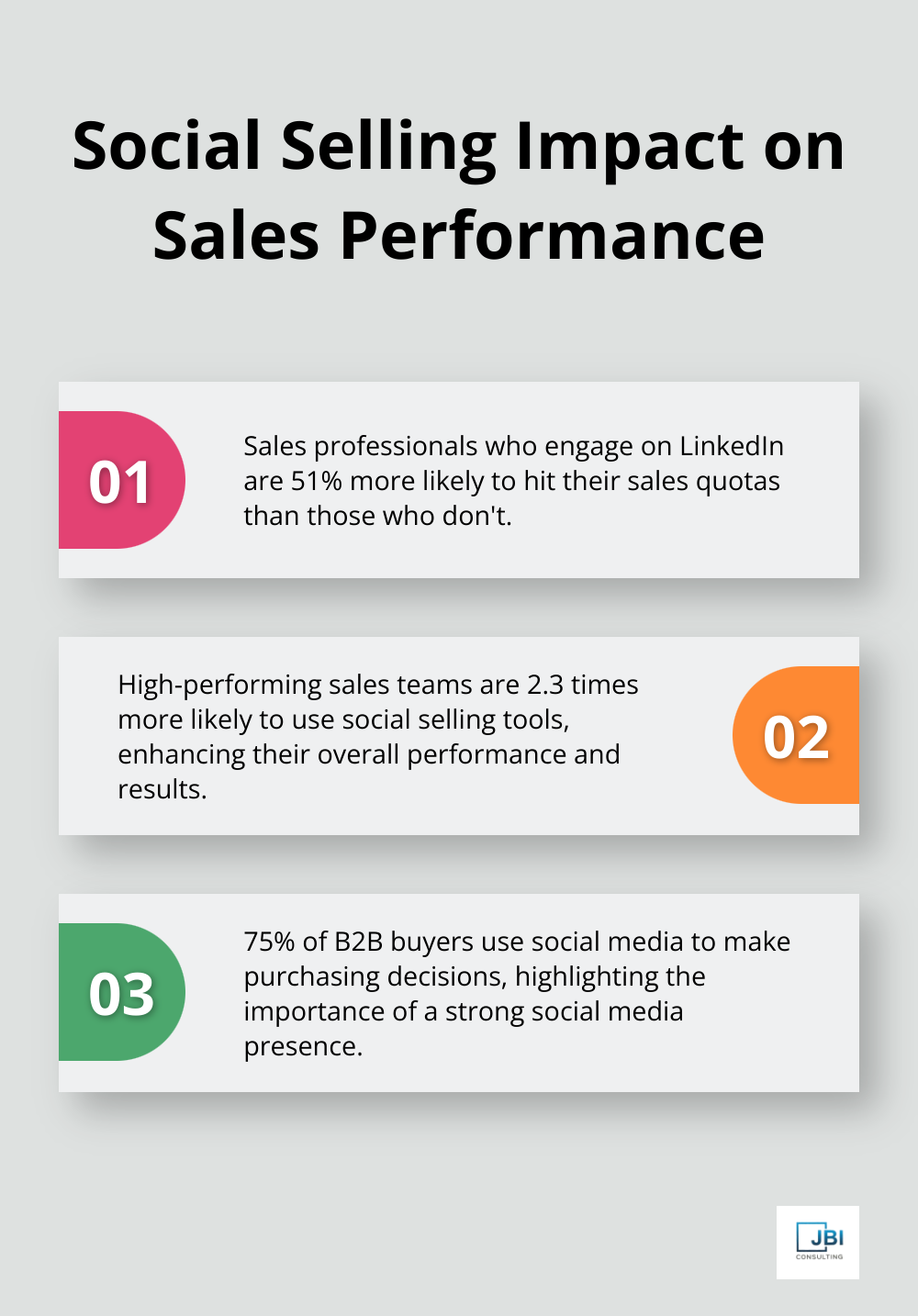
LinkedIn stands out as the premier platform for B2B sales. With over 900 million members worldwide, it offers a goldmine for professional networking and lead generation. Sales teams that effectively use LinkedIn see tangible results. Sales professionals who engage on LinkedIn are 51% more likely to hit their sales quotas than those who don’t.
To maximize LinkedIn’s potential, sales teams should:
- Optimize profiles with industry keywords and achievements
- Share valuable content relevant to their target audience regularly
- Engage with prospects’ posts to build rapport before pitching
- Use LinkedIn’s Sales Navigator tool for advanced prospecting
Harnessing Social Listening for Sales Intelligence
Social listening extends beyond monitoring brand mentions. It involves tuning into industry conversations, understanding pain points, and identifying sales opportunities. Tools like Sprout Social or Hootsuite allow sales teams to track relevant keywords, hashtags, and discussions across multiple platforms.
A Salesforce study found that high-performing sales teams are 2.3 times more likely to use social selling tools. Social listening enables sales professionals to:
- Identify trigger events that signal buying opportunities
- Gather competitive intelligence to inform sales strategies
- Understand customer sentiment to tailor pitches effectively
Building Authentic Relationships Through Social Platforms
Successful social selling hinges on authenticity. It focuses on providing value and building trust rather than aggressive pitching. 75% of B2B buyers use social media to make purchasing decisions, highlighting the importance of social selling in the B2B space.
Effective relationship-building strategies on social media include:
- Sharing industry insights and thought leadership content
- Engaging in meaningful conversations in industry groups
- Offering help and advice without immediate expectation of return
- Personalizing outreach based on prospects’ social media activity
As social media continues to evolve, sales strategies must adapt. The next frontier in sales innovation lies in understanding and responding to shifting customer values and expectations, which leads us to explore the growing importance of value-based selling in today’s market.
Value-Based Selling: Meeting Customer Needs
Value-based selling has become a cornerstone of modern sales strategies. This approach focuses on benefitting the customer throughout the sales process, leading to more meaningful relationships and increased sales success.
Identifying Customer Pain Points
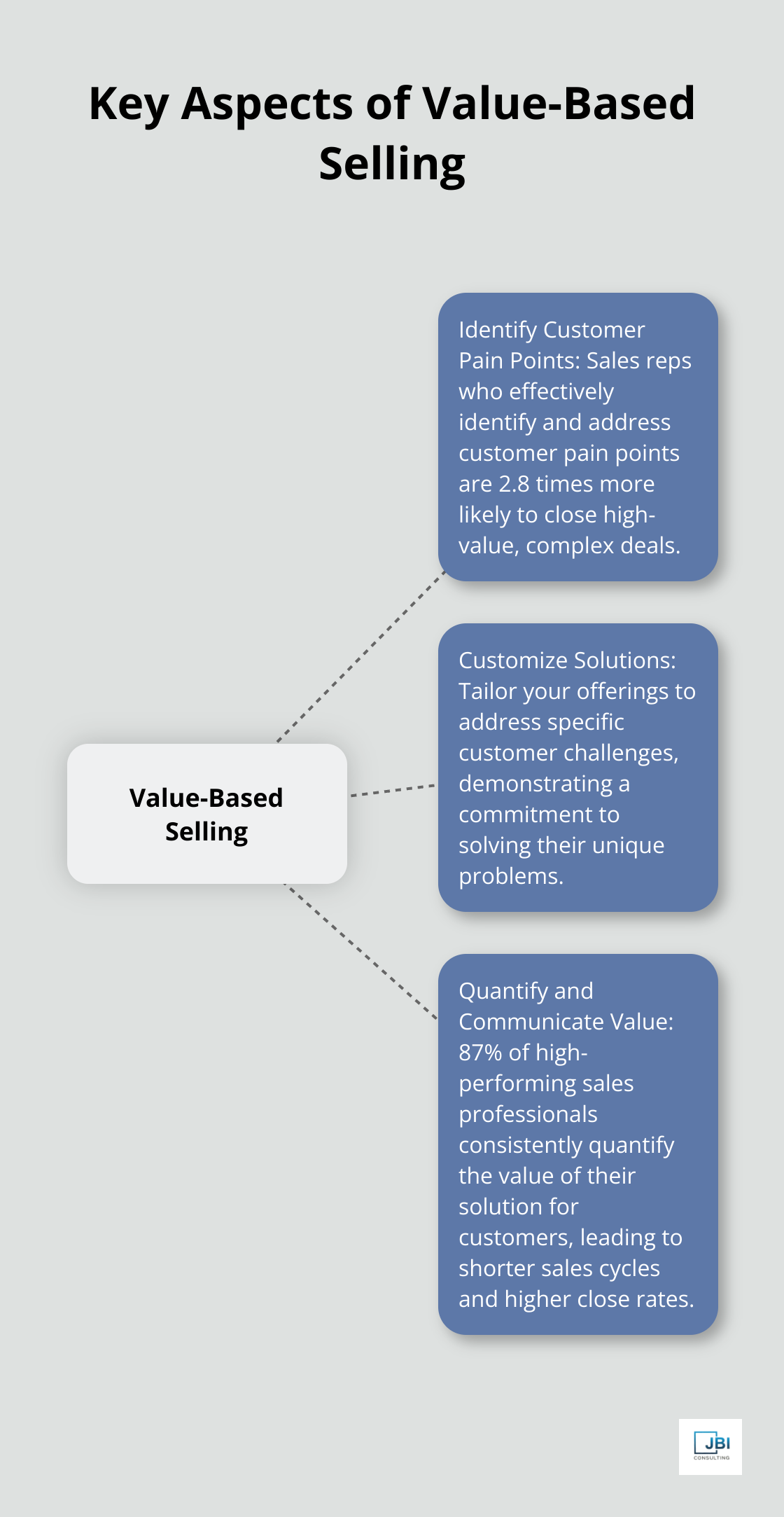
The first step in value-based selling requires sales professionals to uncover customer challenges through active listening and strategic questioning. A study by Gartner reveals that sales reps who effectively identify and address customer pain points are 2.8 times more likely to close high-value, complex deals.
To uncover these pain points:
- Conduct thorough research on the customer’s industry and specific business challenges.
- Ask open-ended questions during sales conversations to encourage customers to share their concerns.
- Use social listening tools to monitor industry discussions and identify common pain points.
Customizing Solutions for Maximum Impact
After identifying customer pain points, sales professionals must tailor their solutions to address these specific needs. This customization demonstrates a commitment to solving the customer’s problems, rather than just pushing a product.
Accenture Life Trends 2025 explores 5 emerging trends transforming interactions and hesitations with brands, organizations & governments. In the B2B space, this translates to higher win rates and larger deal sizes.
To effectively customize solutions:
- Map your product or service features directly to the customer’s pain points.
- Create a solution matrix that outlines how each aspect of your offering addresses specific customer challenges.
- Develop case studies that showcase how similar businesses have benefited from your tailored solutions.
Quantifying and Communicating Value
The final piece of the value-based selling puzzle involves effectively communicating the return on investment (ROI) of your solution. This step translates the benefits of your offering into tangible business outcomes for the customer.
A survey by ValueSelling Associates found that 87% of high-performing sales professionals consistently quantify the value of their solution for customers. This practice leads to shorter sales cycles and higher close rates.
To effectively quantify and communicate value:
- Use ROI calculators to provide concrete figures on potential cost savings or revenue increases.
- Develop before-and-after scenarios that illustrate the impact of your solution on key business metrics.
- Leverage customer success stories (with specific, measurable outcomes) to build credibility.
Value-based selling represents a fundamental shift in sales approaches. Sales professionals who focus on customer needs, tailor solutions, and clearly communicate value can build stronger relationships and drive better business outcomes. As the sales landscape continues to evolve, mastering these techniques will prove essential for staying competitive and achieving long-term success.
Final Thoughts
The sales landscape transforms rapidly, driven by AI, social selling, and value-based approaches. These sales trends reshape how businesses connect with customers and close deals. Successful sales teams integrate technology to enhance human interactions, not replace them. They leverage AI-powered tools for lead scoring and personalization while maintaining the irreplaceable human element in relationship building.
Adapting to new sales techniques proves essential for survival in today’s competitive market. Sales professionals who embrace these trends position themselves at the forefront of the industry. They capitalize on emerging opportunities and overcome challenges by staying informed and adaptable. This proactive approach allows them to create more meaningful connections with customers and drive better business outcomes.
At JBI Consulting, we recognize the importance of navigating this shifting sales landscape. Our transformative sales program equips individuals and teams with the skills needed to thrive in modern sales (focusing on proactive opportunity hunting and refined techniques). As the sales profession undergoes profound changes, continuous adaptation of strategies becomes key to success in this dynamic environment.